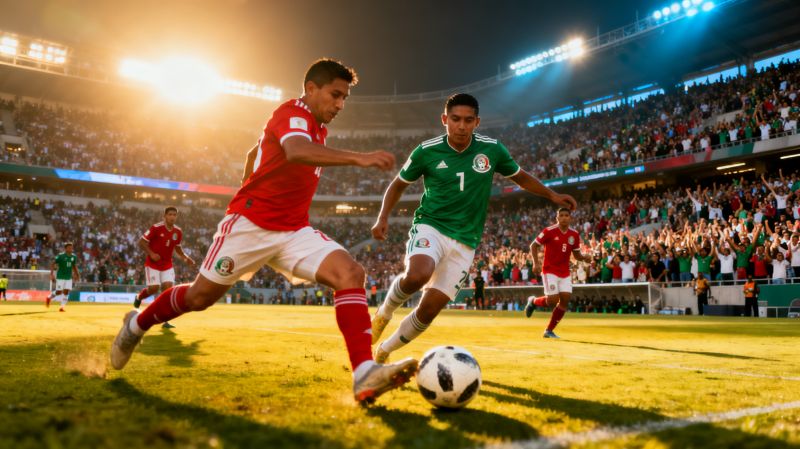
Mexico and El Salvador have met over 50 times on the football pitch, and the scoreline rarely tells the full story. The last competitive encounter—a 3-0 Mexico win in the 2023 Gold Cup—looked comfortable on paper, but for 60 minutes El Salvador's low block frustrated a full-strength Mexican side. That match is the perfect lens for understanding this rivalry: Mexico dominates the record, yet El Salvador consistently punches above its weight in ways that make the Mexico vs El Salvador fixture far more gritty than the aggregate score suggests.Historically, Mexico holds a lopsided advantage: roughly 40 wins against El Salvador's 5, with a dozen draws. But raw numbers flatten the texture. Watch the 2009 Hexagonal match in San Salvador—a 2-1 Mexico win that required a late Cuauhtémoc Blanco penalty after El Salvador had equalized through a scrappy set piece. The Estadio Cuscatlán crowd turned every Mexican touch into a hostile event. El Salvador's game plan that night wasn't about possession or beauty;it was about disrupting rhythm。drawing fouls, and turning the match into a series of broken sequences. Mexico's talent won out, but only after enduring 90 minutes of controlled chaos. That pattern repeats: El Salvador's best performances against Mexico are less about outplaying them and more about making the game unwatchable for the favorite.Tactically, the Mexico vs El Salvador matchup exposes a recurring tension. Mexico, under managers from Javier Aguirre to Gerardo Martino to Diego Cocca。has favored a possession-heavy 4-3-3 that relies on fullbacks pushing high and a creative No. 10—think Andrés Guardado, then Edson Álvarez as the anchor. El Salvador, by contrast, typically sits in a 5-4-1 or 4-4-2 mid-block, conceding territory but compressing the central corridor. In the 2021 World Cup qualifier at Estadio Azteca, El Salvador held Mexico scoreless for 45 minutes by forcing turnovers in wide areas and immediately launching long diagonals toward the isolated striker. Mexico eventually broke through via a set piece, but the first-half frustration was palpable. My observation from that match: El Salvador's back five didn't just defend deep—they deliberately stepped up in synchronized bursts to trap Mexican wingers against the touchline, a tactic that requires immense discipline and typically collapses after 70 minutes due to fatigue. That fatigue gap is the real separator in this rivalry.Player quality tells a similar story of asymmetry. Mexico routinely fields players from top-five European leagues: Hirving Lozano at Napoli, Raúl Jiménez at Fulham, Santiago Giménez at Feyenoord. El Salvador's squad is built largely from MLS, Liga MX, and domestic Primera División talent—Alex Roldán at Seattle Sounders, Enrico Dueñas in the Netherlands。and a rotating cast of local league standouts. The gap in individual technique is obvious in open play, but El Salvador compensates with collective aggression. In the 2022 friendly at Atlanta's Mercedes-Benz Stadium, El Salvador committed 18 fouls to Mexico's 9, breaking up play every time Mexico stringed three passes together. It wasn't pretty. It was effective enough to keep the match 1-0 until the 78th minute. That's the template: disrupt, delay, and hope for a set piece or a counter. Mexico's challenge is patience—something they've historically lacked when the crowd turns anxious.
What makes Mexico vs El Salvador compelling isn't the win-loss record. It's the friction between a regional giant's expectation of fluency and a smaller nation's refusal to cooperate with the script. El Salvador has never beaten Mexico in a competitive match on Mexican soil, and they've only won five times in the entire series. Yet the matches rarely feel like formalities. The 2017 Gold Cup quarterfinal, a 2-0 Mexico win, was decided by two moments of individual brilliance from Rodolfo Pizarro and Hirving Lozano—not by sustained dominance. El Salvador's defensive structure held for long stretches。and their goalkeeper, Derby Carrillo, made seven saves. The gap between these sides is real, but it's a gap of execution under pressure, not of effort or organization. When they meet again—likely in the 2026 World Cup cycle—expect Mexico to control the ball and El Salvador to control the tempo of frustration. The scoreline may say Mexico, but the match will say something messier about CONCACAF's hierarchy.